The question is not “are we sure?”
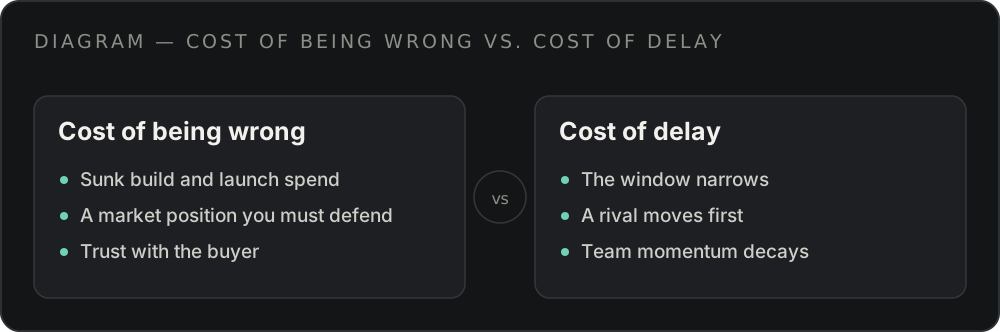
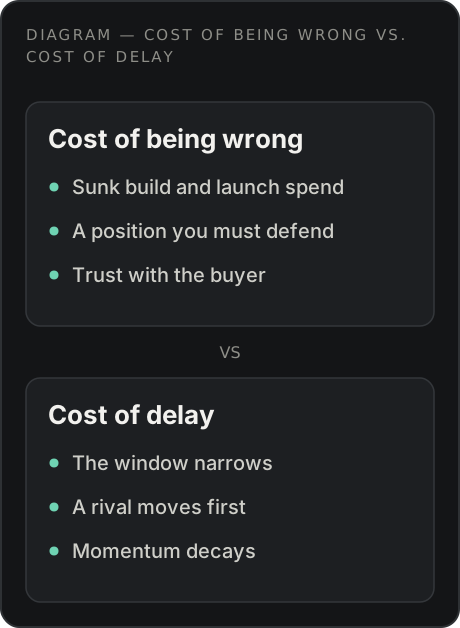
Teams tend to argue about confidence when they should be arguing about cost. The useful question is not whether you are certain, but what being wrong would cost relative to what waiting would cost.
Write both down as numbers or ranges. Most launch debates dissolve once the two costs are visible side by side.
When speed is the stronger form of evidence
For reversible, cheap, fast-feedback moves, launching is the validation. A limited release generates behavioural evidence no study can match, and the downside is bounded.
Validation earns its keep when the move is expensive, slow to reverse, reputationally visible, or when it commits the organisation to a position — a price, a proposition, a market — that will be hard to walk back.
Three questions that decide the sequence
How reversible is this? How long until real feedback arrives? How much of the plan rests on one untested belief? Three cheap answers usually settle the sequence better than another week of debate.
What a minimum useful test looks like
A useful test is not a smaller version of the launch. It is the narrowest thing that could change your decision: one segment, one price, one claim, one channel. If a test cannot change the decision, it is reassurance, not evidence.
Validate when being wrong is expensive. Launch when waiting is.
- If this fails, what does it cost to undo?
- How long before we would know?
- Which single belief carries the most weight?
- What is the narrowest test of that belief?
ATLASIO.ai lets you set up this kind of question as a scenario and explore how simulated customers and market actors could respond, using the evidence you already hold. Results are decision-support signals — possible outcomes, not guarantees.
Editorial perspective. No customer names, studies, statistics or results are cited on this page.