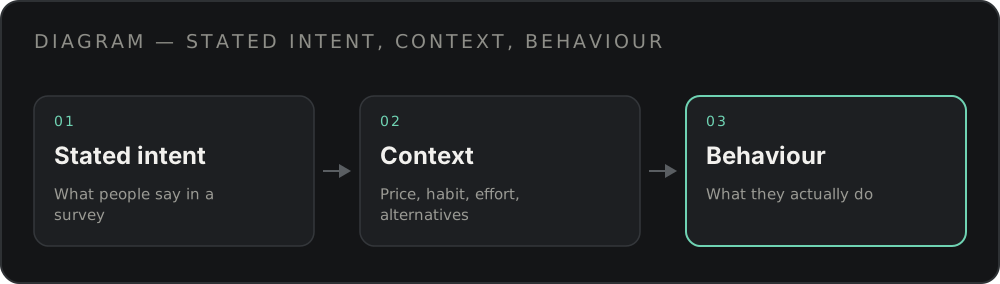
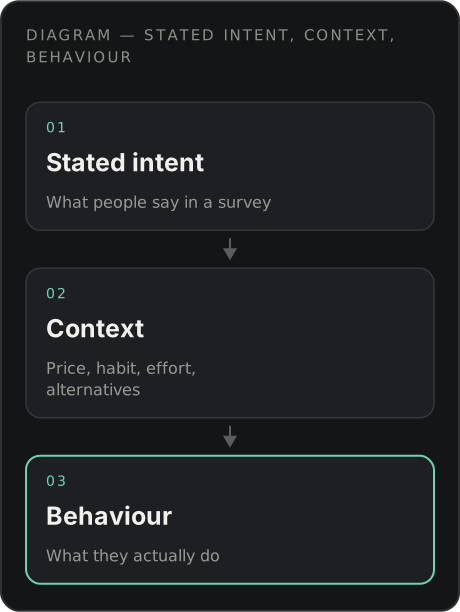
Intent is measured in a room; behaviour happens in a market
When someone answers a question about a product, they answer as a considered, attentive, unhurried version of themselves. When they meet the same product in the world, they are distracted, price-anchored, loyal to something else, and three clicks from an alternative.
The gap between the two is not dishonesty. It is context. Stated intent captures preference under ideal attention; behaviour captures choice under real friction.
Why the gap widens exactly where it matters
The gap is smallest for familiar, low-stakes, well-understood choices and widest for the ones businesses most want to research: new categories, premium positioning, switching costs, unfamiliar propositions. The less experience someone has with a decision, the less their stated answer predicts their behaviour.
Read signals, not opinions
Behavioural signals are things people do at some cost: trading off, choosing between bundles, abandoning, returning, recommending, paying more for one option over another. Opinions are free; trade-offs are informative.
The same principle applies to simulated responses. A useful simulation does not ask whether an audience approves of an idea. It puts the idea against alternatives and observes where a possible response changes.
Designing questions that survive the gap
Replace “would you buy this?” with a forced choice against real alternatives. Add price. Add the competitor. Add the reason not to switch. Ask about the last real decision instead of the next imagined one. Then treat the result as a possible direction, not a projection.
Opinions are free. Trade-offs are evidence.
- Did the question require giving something up?
- Was a real alternative present in the choice?
- Are we reading approval, or reading behaviour?
- What would this audience have to stop doing for us to win?
ATLASIO.ai lets you set up this kind of question as a scenario and explore how simulated customers and market actors could respond, using the evidence you already hold. Results are decision-support signals — possible outcomes, not guarantees.
Editorial perspective. No customer names, studies, statistics or results are cited on this page.