What a competitor’s price actually tells you
A competitor’s price encodes their cost base, their funding position, their channel margins, their customer mix and their history of discounting. It does not encode what your customers would pay for your offer. Copying the number imports their constraints without their advantages.
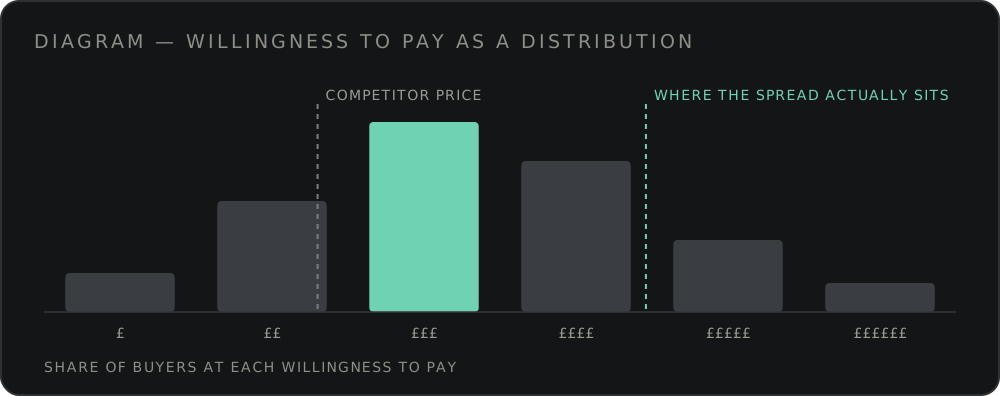
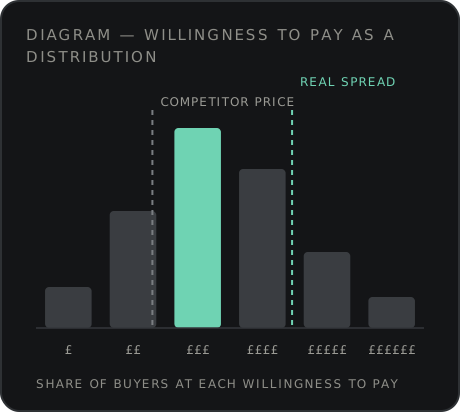
Willingness to pay is a distribution, not a point
There is no single price a market will bear. There is a spread across segments, and every price is a choice about which part of that spread you serve and which you decline.
Framed this way, a price change is a positioning decision with a revenue side-effect. The question shifts from “what is the right price?” to “which customers do we want, and what does that imply?”
The consequences a price move triggers
Price moves change who arrives, what they expect, how they compare you, what your sales motion has to explain, and how your competitors respond. A price that clears on a spreadsheet can still fail on positioning.
Exploring price scenarios before committing
Instead of picking a number, build two or three price positions with the story that goes with each — the claim, the packaging, the audience it invites, the audience it loses — and explore how possible responses differ. Then test the most consequential one narrowly before you reprice everything.
A price is not a number. It is a statement about who you are for.
- Which segment does this price invite, and which does it turn away?
- What claim has to be true for it to feel fair?
- How would a competitor most cheaply undercut the move?
- What would we test first, and in which market?
ATLASIO.ai lets you set up this kind of question as a scenario and explore how simulated customers and market actors could respond, using the evidence you already hold. Results are decision-support signals — possible outcomes, not guarantees.
Editorial perspective. No customer names, studies, statistics or results are cited on this page.