Why this decision goes wrong
Entry decisions are attractive because the upside is easy to describe and the failure modes are not. Most of the risk sits in the parts of the market you cannot see from outside it.
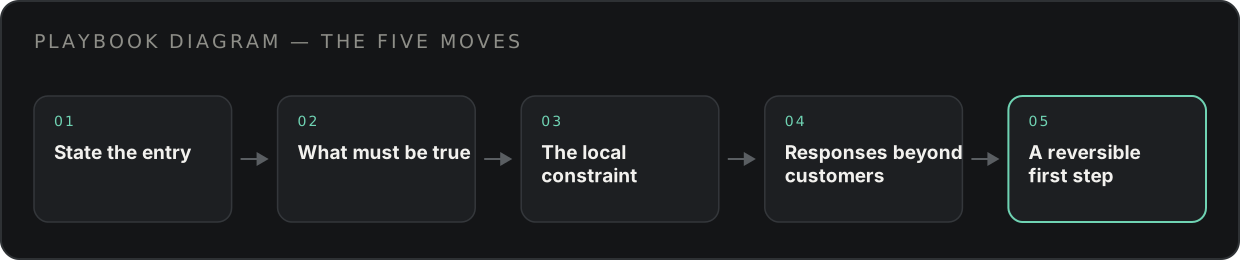
The five moves
- 01State the entry, not the ambitionWhich market, which segment first, which proposition, at what price, through which route. “Expanding to the region” is not a decision.
- 02Name what would have to be trueThe problem exists in the same form, the incumbents are beatable on something specific, the route to buyers exists, and the unit economics survive local costs.
- 03Look for the local reason it failsRegulation, distribution control, entrenched habits, price expectations, trust and brand unfamiliarity. Every entry has one dominant local constraint.
- 04Explore responses from more than customersIncumbents, partners, channels and regulators all respond. Examine how each could react to your specific entry.
- 05Choose a reversible first stepA single city, a single partner, a single segment. Design the entry so that being wrong costs a quarter, not a year.
What you bring
- Target market and first segment
- Proposition and price for that market
- Incumbents and their positions
- Route-to-market options
- Cost and regulatory constraints
What you get out
- Comparison of entry routes
- The dominant local constraint
- Possible responses from customers, incumbents and channels
- A reversible first step and its success signals
Common failure modes
- Assuming the home-market proposition travels intact
- Underestimating distribution control
- Treating market size as a reason to enter
- Committing before a reversible test
Running it in ATLASIO.ai
Set the decision up as a scenario, add the evidence you hold, and explore how simulated customers and market actors could respond to each alternative. The output is decision support — possible outcomes and the assumptions behind them, not a guarantee.