Most decision processes run backwards
Most decision processes begin with the evidence a company happens to hold — last quarter’s numbers, a research deck, a competitor scan — and work forwards to a conclusion. That sequence works well when the future resembles the past. It works poorly for the decisions that matter most: a new price, a new market, a new proposition, a new audience. Those are precisely the moves for which no historical record exists.
The result is a familiar pattern. A team gathers a great deal of context, produces a confident recommendation, and discovers only after committing resources that the context never actually discriminated between the options on the table.
Start from the decision, not the data
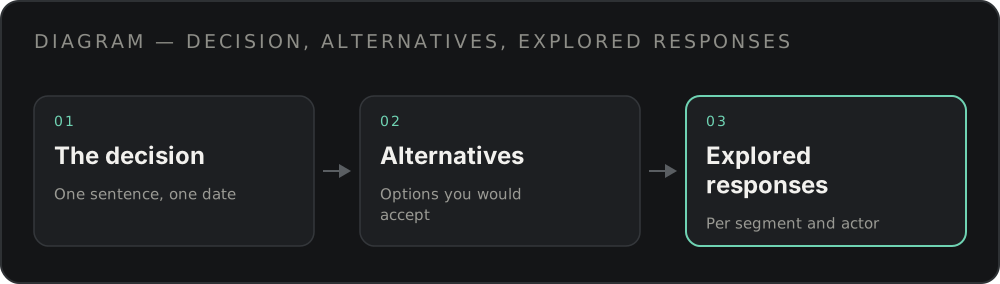
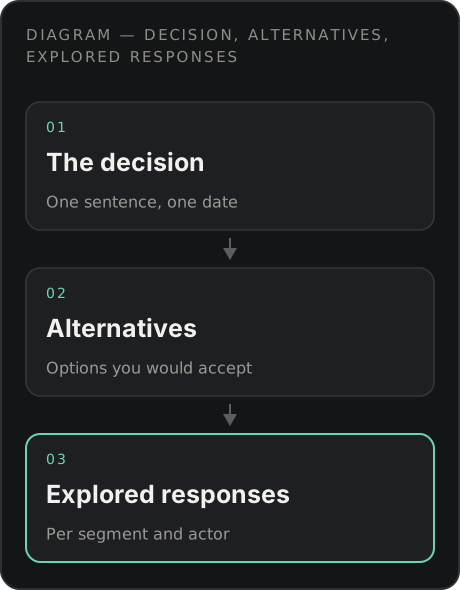
A more useful sequence starts with the decision itself. State the move in a single sentence. Name the alternatives you are genuinely willing to take — including the option of doing nothing. Only then ask what evidence would separate them.
This inversion changes what counts as useful information. You stop collecting context and start collecting discrimination: signals that make one path look meaningfully different from another. Anything that would leave you choosing the same option regardless of the answer is interesting, but it is not decision evidence.
Where simulation fits
Simulation is one way to generate that discrimination when real-world evidence is unavailable, slow or expensive. Instead of asking what customers say they would do, you explore how simulated customers and market actors might respond to each alternative, and where those responses diverge.
The value is not a single number. The value is the shape of the disagreement between paths, and the assumptions that shape depends on. A path that looks strong under every assumption you can defend is a different kind of finding from a path that looks strong only if one fragile belief holds.
Read the output as an argument, not a verdict
A simulated response is a structured argument about what could happen, built on available evidence and stated assumptions. It is decision support. It is not a forecast, and it does not guarantee an outcome.
Its most valuable product is often a short list of things worth testing cheaply in the real world before committing: a pilot, a price test, a single market, a narrow launch. Exploration tells you where to spend your validation budget; it does not replace validation.
A working sequence
Frame the move in one sentence. Name three or four alternatives. Write down the beliefs each alternative depends on. Explore possible responses to each. Compare where they diverge. Then choose the cheapest real-world test that would change your mind — and run it before the full commitment.
The point of exploring a decision is not to remove uncertainty. It is to learn which uncertainty is worth paying to resolve.
- Can you state the decision in one sentence without using the word “strategy”?
- Which alternative would you take if the evidence came back neutral?
- What single belief, if wrong, would break the plan?
- What is the cheapest real-world test of that belief?
ATLASIO.ai lets you set up this kind of question as a scenario and explore how simulated customers and market actors could respond, using the evidence you already hold. Results are decision-support signals — possible outcomes, not guarantees.
Editorial perspective. No customer names, studies, statistics or results are cited on this page.